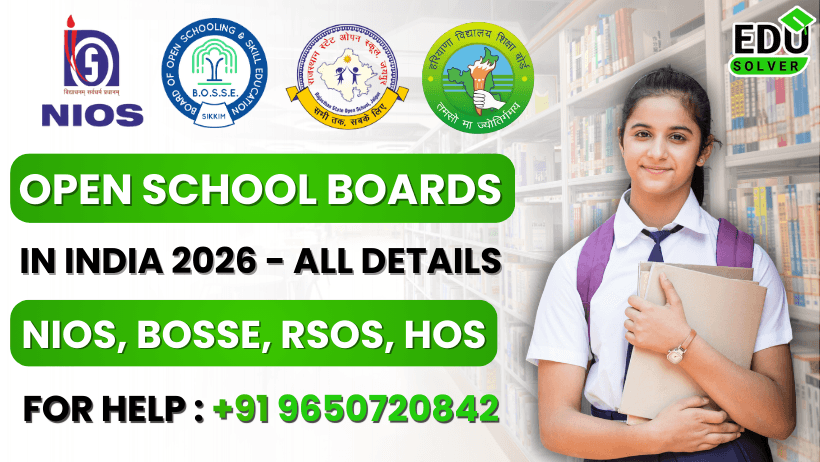
The major open school boards in India—NIOS, BOSSE, RSOS, and HOS – offer flexible and recognized education options for students who cannot attend regular schools. These boards allow learners to study at their own pace, choose subjects freely, and appear for exams when ready. In 2026, open schooling continues to be a convenient pathway for completing Class 10 and 12 with valid certification for jobs and higher education.
Open school boards in India are educational boards that provide flexible learning options for students outside the traditional classroom setup. They are designed for:
Students who dropped out of regular school.
Working professionals or athletes needing flexible study hours.
Students in remote areas with limited access to schools.
Individuals seeking equivalency certifications for further studies.
Open school boards follow the same educational standards and curricula recognized by UGC, AICTE, and state education departments, allowing students to pursue higher education, vocational training, or employment.
Here are the most recognized open school boards in India:
A. NIOS – National Institute of Open Schooling
Overview:
The National Institute of Open Schooling (NIOS) is a central government initiative providing education for secondary (Class 10) and senior secondary (Class 12) levels.
Key Features:
Flexible syllabus and study schedule.
Offers academic, vocational, and life enrichment courses.
Provides study materials and online learning resources.
Eligibility:
Students of any age can enroll in NIOS.
For secondary courses: Minimum age 14 years.
For senior secondary: Minimum age 15 years.
Exams and Assessment:
Conducts exams twice a year (April–May, October–November).
Offers subject-wise exams; students can choose which subjects to appear for in each session.
Advantages:
Recognized for admission to higher education in India and abroad.
Flexible learning with no strict age limits.
Opportunity to learn vocational skills alongside academics.
B. BOSSE – Board of Open Schooling and Skill Education
Overview:
BOSSE is a national-level board providing education for students in remote areas or those seeking a flexible study schedule. BOSSE emphasizes skill-based and academic education.
Key Features:
Offers secondary and senior secondary courses.
Integrated skill development programs.
Online registration and study support.
Eligibility:
Students who have completed Class 8 or equivalent for secondary level.
Senior secondary: Minimum age 15 years.
Exam Pattern:
Annual or bi-annual examinations depending on the course.
Practical and project-based assessments for skill programs.
Advantages:
Recognized by various universities and employment sectors.
Focus on vocational and skill development courses.
C. RSOS – Rajasthan State Open School
Overview:
RSOS is a state-level open school providing flexible education options in Rajasthan for secondary and senior secondary students.
Key Features:
Offers academic courses and vocational programs.
Provides printed study material and online support.
Affordable course fees for students from all backgrounds.
Eligibility:
Secondary courses: Students must have passed Class 8.
Senior secondary courses: Students must have completed Class 10.
Exam Pattern:
Conducts annual exams for secondary and senior secondary courses.
Subject-wise exams, with options to clear backlog subjects.
Advantages:
Widely recognized by state and central universities.
Ideal for rural students and those seeking low-cost education options.
D. HOS – Haryana Open School
Overview:
HOS provides alternative schooling options for students in Haryana and neighboring states. It focuses on flexibility and skill enhancement.
Key Features:
Offers secondary and senior secondary courses.
Provides flexible registration and course completion timelines.
Vocational and skill-based subjects available.
Eligibility:
Secondary: Minimum age 14 years.
Senior secondary: Minimum age 15 years.
Exam Pattern:
Exams conducted once or twice a year.
Option for subject-wise examination to clear pending subjects.
Advantages:
Recognized for higher education and employment in Haryana and across India.
Allows students to study while managing personal or work commitments.
Open school boards provide both academic and vocational courses:
Academic Courses:
Secondary (Class 10)
Senior Secondary (Class 12)
Vocational Courses:
IT and Computer Applications
Retail and Sales Management
Health and Paramedical Courses
Business and Financial Management
Life Enrichment Courses:
Personality Development
Communication Skills
Environmental Studies
These courses allow students to gain both theoretical knowledge and practical skills, making them employable immediately after completion.
Eligibility differs slightly between boards but generally includes:
Minimum age requirement: 14–15 years for secondary and senior secondary courses.
Educational qualification: Completion of previous class (Class 8 for secondary, Class 10 for senior secondary).
No upper age limit: Students of any age can enroll.
Special provisions: Some boards allow dropout students, working professionals, and students with learning difficulties to enroll.
Visit the official website of the respective board.
Register online by providing personal details and academic qualifications.
Upload necessary documents (previous marksheet, identity proof, photo).
Pay course fees through online or offline mode.
Receive enrollment confirmation and study materials.
Most open school boards also offer counseling support for students who are uncertain about courses or subjects.
Flexible exams: Subject-wise exams allow students to clear courses at their own pace.
Frequency: Most boards conduct exams twice a year (April–May and October–November).
Assessment: Some boards include project work and practical exams, especially for vocational courses.
Result declaration: Results are usually declared online within 1–2 months after exams.
Flexible Learning: Study at your own pace without attending regular classes.
Cost-Effective: Lower fees compared to regular schooling.
Accessibility: Ideal for rural students and those in remote locations.
Higher Education: Recognized by universities for admission to UG courses.
Employment Opportunities: Vocational courses make students job-ready.
No Age Limit: Students of any age can complete their secondary or senior secondary education.
While open schooling has numerous advantages, students should be aware of some challenges:
Self-Discipline Required: Students must be motivated to study independently.
Limited Peer Interaction: Lack of regular classroom environment may affect social learning.
University Recognition: Always choose UGC/AICTE-approved boards to ensure higher education eligibility.
Examination Preparation: Some students may require additional coaching or guidance for exam readiness.
Increasing digital learning platforms make open schooling more interactive and accessible.
Governments and private institutions are expanding vocational courses to meet industry demand.
Recognition for higher studies and employment ensures that open schooling is a credible alternative to conventional education in 2026.
Integration of online exams, e-learning, and virtual classrooms will further strengthen open school education.
Open school boards in India are gradually becoming a mainstream education alternative, empowering students who cannot pursue traditional schooling.
While open schooling offers flexibility, students need self-discipline and planning to succeed. Here are some tips:
Create a Study Schedule:
Plan daily or weekly study hours for each subject to ensure consistent learning.
Set Clear Goals:
Set short-term goals (like completing a chapter) and long-term goals (clearing all subjects in one exam session).
Utilize Study Materials:
Make full use of textbooks, online videos, and practice papers provided by boards like NIOS, BOSSE, RSOS, and HOS.
Join Online Study Groups:
Discussing topics with peers or mentors online improves understanding and motivation.
Practice Previous Year Papers:
Solving sample papers and previous exam papers helps familiarize with the pattern and time management.
Balance Work and Study:
Many open school students work while studying; allocate fixed hours for study to maintain balance.
Seek Guidance When Needed:
Reach out to teachers, mentors, or online forums if you face difficulties in certain subjects.
Here’s a quick comparison of NIOS, BOSSE, RSOS, and HOS:
| Feature | NIOS | BOSSE | RSOS | HOS |
|---|---|---|---|---|
| Level | Secondary & Senior Secondary | Secondary & Senior Secondary | Secondary & Senior Secondary | Secondary & Senior Secondary |
| Vocational Courses | Yes | Yes | Limited | Yes |
| Age Limit | No upper limit | No upper limit | No upper limit | No upper limit |
| Exams | Twice a year | Once or twice a year | Annually | Once or twice a year |
| Study Mode | Online & Self-Study | Online & Self-Study | Print & Online | Print & Online |
| Recognition | National & International | National | State & National | State & National |
This comparison helps students choose the best open school board in India according to their location, course preference, and career goals.
With the growth of digital education, open school boards are increasingly adopting online study tools:
E-Learning Platforms: Many boards provide access to online lectures, tutorials, and e-books.
Virtual Classrooms: Some boards offer live interactive sessions for difficult subjects.
Mobile Apps: Students can access study material, practice tests, and announcements on mobile apps.
Online Exam Registration: Registration and result checking are now completely online for most boards.
Digital learning makes open school boards in India 2026 more accessible, interactive, and aligned with modern education trends.
Completing secondary or senior secondary education through open school boards allows students to pursue:
Undergraduate Programs: BA, B.Com, B.Sc, BBA, BCA, and other vocational degrees.
Competitive Exams: Many government exams accept open school qualifications for eligibility.
Skill-Based Jobs: Vocational courses from open school boards help students get jobs in IT, healthcare, retail, and business sectors.
Entrepreneurship: Knowledge from open school courses can help students start small businesses or freelance careers.
Students from open school boards in India have successfully pursued careers in education, banking, IT, hospitality, and public services.
Open school boards in India provide flexible, affordable, and recognized education options for students who cannot pursue regular schooling. Boards like NIOS, BOSSE, RSOS, and HOS ensure that students can complete their secondary or senior secondary education, gain vocational skills, and pursue higher education or employment. With increasing digital platforms and recognition, open school boards in India 2026 are becoming a credible and accessible alternative to traditional education.
Whether you are a dropout, a working professional, or someone looking for flexible education, open school boards in India offer the perfect pathway to achieve your academic and career goals.
Open school boards provide flexible learning options for students outside the conventional classroom system, including NIOS, BOSSE, RSOS, and HOS.
Students of any age, dropouts, working professionals, and students from remote areas can enroll. Minimum age for secondary courses is 14–15 years.
Yes, certificates from UGC/AICTE-approved boards are recognized for higher education and government/private jobs.
Secondary (Class 10), Senior Secondary (Class 12), vocational courses, and life enrichment programs.